Swiss hospitality working hours: what the CCNT means for your team schedule

In Switzerland, planning staff schedules for a restaurant, bar, café or hotel means following several rules. The Swiss Labour Act (LTr) and its implementing ordinances set requirements for matters such as breaks, daily rest and night work. The National Collective Labour Agreement for Hotels, Restaurants and Cafés (CCNT) adds industry-specific provisions covering areas such as working hours, holidays, public holidays and the 13th salary.
Here are the key points to check when preparing your team schedule. This guide is a practical summary; the official legal texts take precedence.
1. How many hours can your team work each week?
Under the CCNT, the standard working time averages 42 hours per week. Different limits apply to certain categories of establishments:
- 42 hours per week on average under the standard regime.
- 43.5 hours for qualifying seasonal establishments.
- 45 hours for qualifying small establishments.
The Swiss Labour Act also sets a maximum weekly working time. For workers who do not fall into categories subject to the 45-hour limit, this is generally 50 hours.
These figures serve different purposes: the CCNT defines the applicable average working time, while the law sets a maximum limit. Check which category applies to your establishment and how working hours must be calculated over the relevant reference period.
2. What breaks must you schedule during the working day?
The Swiss Labour Act sets minimum break requirements based on the length of the working day. Breaks are not optional and should be taken into account when planning shifts.
The minimum breaks are:
- More than 5.5 hours of work: at least 15 minutes.
- More than 7 hours of work: at least 30 minutes.
- More than 9 hours of work: at least 60 minutes.
Breaks must be organised so that employees can actually rest. How they are treated in working-time records depends, among other things, on the conditions under which they are taken. Consult the official rules for specific situations.
3. How much rest is required between shifts?
As a general rule, employees must receive at least 11 consecutive hours of daily rest between working periods.
This is easy to overlook when preparing a hospitality schedule. An employee who finishes a late closing shift and starts early the next morning may not receive the required rest period.
For adult workers, daily rest may be reduced to eight hours once a week under certain conditions. The average rest period over two weeks must then reach 11 hours. The law also restricts the use of overtime following a reduced rest period.
When checking a schedule, look at the transitions between shifts, not just the length of each working day.
4. How many rest days, holidays and public holidays must you provide?
The CCNT generally provides for two rest days per week, subject to the calculation rules set out in the agreement.
Employees are entitled to five weeks of annual leave per year of service. This increases to six weeks for employees under the age of 20.
The CCNT also provides for six paid public holidays per year, subject to the conditions of the agreement, as well as a 13th salary.
The calculation and compensation rules may vary depending on the employee’s situation. If you are unsure, consult the relevant provisions of the CCNT.
5. What are the rules for night and Sunday work?
Night work and Sunday work are subject to specific rules. As a general rule, the night period runs from 11 p.m. to 6 a.m., subject to adjustments permitted by law.
The hospitality industry benefits from specific provisions for organising work during these periods. However, these provisions do not remove all requirements relating to employee protection, rest periods or compensation.
The rules that apply depend, among other things, on the type and frequency of the work. To determine which authorisations or compensation arrangements apply to a particular situation, consult the relevant official provisions.
6. When must you communicate the schedule, and how should changes be handled?
The CCNT sets rules for preparing work schedules and making subsequent changes. As a general rule, establishments that operate year-round must prepare schedules in writing, in consultation with employees, two weeks in advance for a two-week period. For qualifying seasonal establishments, the schedule must generally be prepared one week in advance for a one-week period.
Except in emergencies, subsequent changes must be agreed upon by both parties.
For managers, this means that creating a schedule is only part of the job. You also need a clear process for sharing it with the team and handling shift changes, swaps and absences.
Check Article 21 of the CCNT for the precise requirements that apply to your establishment.
7. How should you record the hours employees actually work?
Recording working time is an important employer responsibility. Article 46 of the Swiss Labour Act and the relevant provisions of its implementing ordinance set out requirements for documenting and retaining working-time records.
It is important to distinguish between scheduled hours and hours actually worked. Records must document working time in accordance with the applicable rules, including start and end times, breaks and rest days where these details must be recorded.
The required records must be retained for at least five years. Employers must be able to produce them in the event of an inspection.
For a precise list of the information you must record, including any simplified arrangements that may apply, consult the official provisions relevant to your business.
Recording working time is an important employer responsibility. Article 46 of the Swiss Labour Act and the relevant provisions of its implementing ordinance set out requirements for documenting and retaining working-time records.
How can Shifta help you manage your schedule?
Shifta is not a legal compliance tool and does not replace your fiduciary, payroll specialist or legal adviser. It can, however, help you organise your team’s schedule and working-time information.
When you create a shift or approve a shift swap, Shifta flags scheduling conflicts and shift sequences where the rest period appears too short, helping you review the schedule before sharing it with your team.
You can also see planned hours and estimated labour costs as you build the schedule. When employees record their hours in the app, the information is collected over time instead of having to be reconstructed at the end of the year.
These features help you organise and monitor working time. The employer remains responsible for checking that schedules and records comply with the rules applicable to the establishment.
Want to simplify staff scheduling? Discover how Shifta can help you prepare schedules, manage changes and keep track of the hours your team works.
Official sources
- National Collective Labour Agreement for Hotels, Restaurants and Cafés (CCNT), English PDF
- Swiss Labour Act: SECO guidance on working hours, breaks and rest periods
- SECO: Labour, official English-language overview
- Swiss Labour Act (LTr, RS 822.11), official legislation in French
- Ordinance 1 to the Labour Act (OLT 1, RS 822.111), official legislation in French
- GastroSuisse, Swiss hospitality industry association
English translations and summaries are provided for information. Where an English translation is not available, consult the official legislation in French, German or Italian. The legally authoritative text takes precedence. This guide provides general information and does not constitute legal advice. The official texts take precedence and may be updated. Check the current provisions before making decisions about working schedules or employment conditions.
Frequently asked questions about the CCNT and working hours
How many hours a week can an employee under the CCNT work?
The standard is 42 hours a week on average. It rises to 43.5 hours in seasonal establishments and to 45 hours in establishments with fewer than five employees. The Labour Act also sets a weekly maximum of 50 hours for the industry.
Which breaks are mandatory in hospitality?
At least 15 minutes beyond 5.5 hours of work, at least 30 minutes beyond 7 hours, and at least 60 minutes beyond 9 hours. A break of half an hour or more must appear in the working-time record.
How much rest must there be between two shifts?
At least eleven consecutive hours. For an adult worker, this rest can drop to eight hours once a week, provided the average over two weeks reaches eleven hours.
How many weeks of holiday does the CCNT provide?
Five weeks per year of service, and six weeks for employees under twenty. The agreement also provides six paid public holidays a year and a 13th salary.
Do I have to record my team's hours?
Yes. Article 46 of the Labour Act and article 73 of Ordinance 1 require the working time actually performed to be documented, with start and end times, rest days and breaks of half an hour or more. The records must be kept for at least five years.
Is scheduling software enough to be compliant?
No. Software helps you build schedules that respect rest periods and keep a record of hours worked, which covers a good part of the recording obligation. It does not replace reading the texts, or your fiduciary's advice on your particular situation.
Related articles
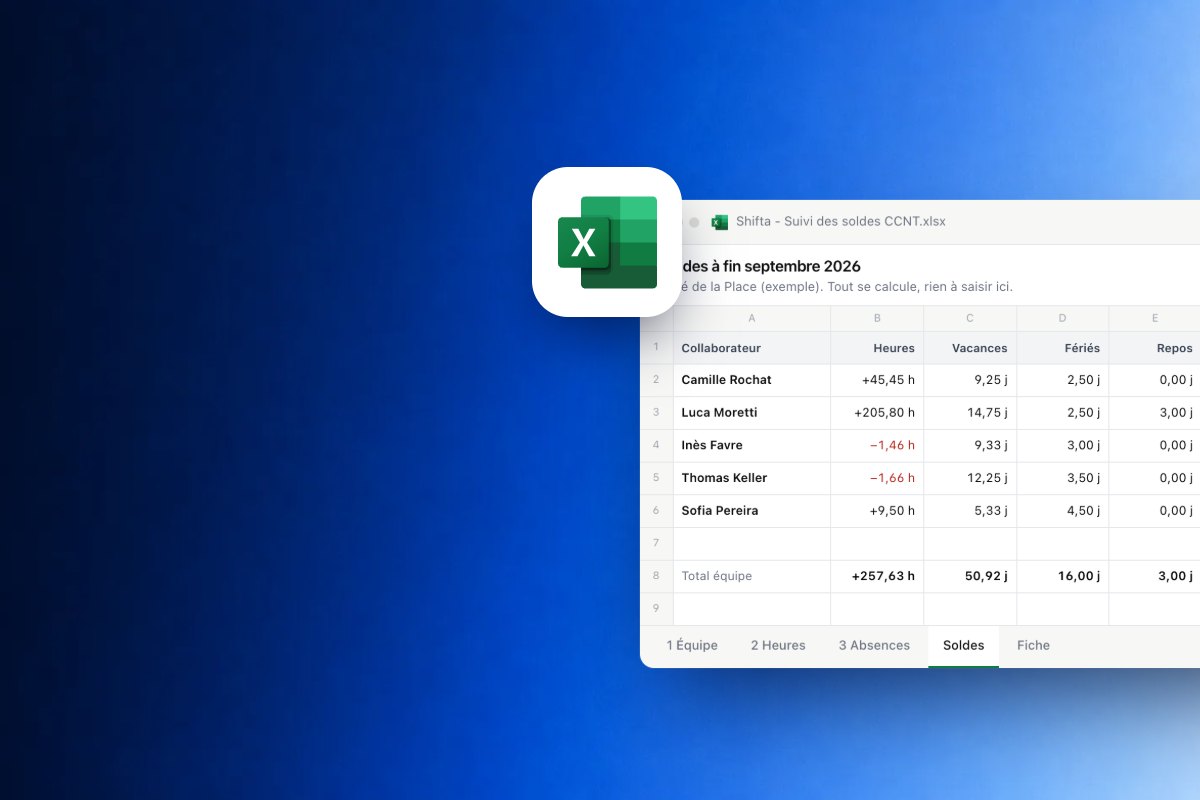
Free Excel template: track your team’s hours and holidays
A ready-to-fill workbook that works out the four L-GAV balances: hours, holidays, public holidays and rest days. Free, sent by email.

The best staff scheduling software in 2026
Seven tools compared for a Swiss venue, one price actually checked, and the three questions that settle it faster than any feature list.

Handling last-minute absences without spending an hour on your phone
A text at 16h20, a server off sick. The real cost is invisible: forty minutes lost on the phone, and a replacement nobody records.