The best staff scheduling software in 2026

Most comparison articles in this category copy prices from each other and rarely re-check them. Checking 7shifts across six review sites in August 2026 produced six different prices: 29.99, 34.99, 39.99, 44.99, 69.99 and 84.99 per location per month, in a mix of US and Canadian dollars, several using plan names the vendor retired in 2025. Skello’s own blog gives 79 euros on one page and 89 euros on another.
For several of these products there is no public price at all, because pricing is a quote, and a quote for a Swiss venue is not a French list price. So the table below shows the cost bracket and the pricing model rather than figures. The one price checked directly is in the detail underneath.
The comparison
Seven options, including the one most venues are actually using. Read the pricing model column before the cost column: it is what decides the bill as the team grows.
| Tool | Best for | Pricing model | Hours tracking | Cost |
|---|---|---|---|---|
| 7shifts | Restaurants with 30+ staff per site | Per location | Yes, plan dependent | Free tier, then mid |
| Deputy | Multi-site across several countries | Per person | Yes | Mid to high, rises with headcount |
| Planday | Multi-site, mixed sectors | Per person | Yes | Mid to high, rises with headcount |
| Skello | Groups of several sites | Quote only | Paid module | High for a small venue |
| GastroTime | Venues already with Gastroconsult | Quote, via Gastroconsult | Core of the product | Not published |
| Shifta | Independent Swiss venues, 5 to 25 people | Per venue, published | Yes, on Pro | Low, 14-day trial |
| Excel + WhatsApp | Teams under 5, simple weeks | None | None | Free |
7shifts
The most restaurant-native product here. Its strength is pulling POS sales data in so labour percentage is visible while you build the schedule, and per-location pricing means a large team does not raise the bill. It is built around North America: payroll and hiring are US-only and the compliance features target American scheduling laws. Its Swiss pricing was not checked.
Deputy and Planday
Mature general-purpose workforce platforms rather than restaurant tools. Strong scheduling and time tracking, long integration lists, sold per person per month, so the bill grows with every part-timer. Neither was price-checked for Switzerland.
Skello
Skello knows hospitality properly, handles the French HCR agreement in detail and produces clean payroll variables. For a group of restaurants it is a serious product.
A direct quote in August 2026, for a fifteen-person Swiss venue wanting scheduling and hours on an annual commitment, came to roughly CHF 160 per month. That is reasonable for what it does, and it is built for a larger business than a single café.
GastroTime
GastroTime comes from Gastroconsult and is built around CCNT working time control, with a cloud version and optional badge terminals. Training is included and required for new users. It is time control software with scheduling attached rather than a phone-first product staff open between services. No public price.
Shifta
Shifta is built for single independent Swiss venues rather than groups, in French, German and English, with prices published rather than quoted. It covers the weekly schedule with sections, breaks and templates, open shifts, shifts staff can offer to colleagues or open to the team, time off and availability requests with a real status, hours logged at the end of service or punched on an iPad kiosk, planned against worked hours, timesheet signature, payroll export and team messaging.
Standard at CHF 29.90 per month for one venue and up to ten people, Pro at CHF 39.90 with hours tracking, the time clock and CHF 20 per extra venue, and 15% off when billed yearly. It does not run payroll, and a 60-person hotel with three outlets will outgrow it.
Excel, paper and WhatsApp
Still the market leader, and adequate until the schedule has two versions in circulation, nobody can answer "who is working Saturday" without scrolling, or hours become a monthly argument.
How to choose
Three questions settle it faster than a feature list.
- Scheduling only, or scheduling plus hours? This sets the price bracket. Publishing a schedule is cheap and solved. Recording worked hours, comparing them to planned hours and exporting for payroll is where products start charging seriously, often as a second module.
- Per venue or per person? Ask for the total at your real headcount. A tool at 4 per employee is 100 per month for a team of 25.
- Will your staff open it? Managers use whatever they are given. Staff use it if it works on an old phone with bad reception in a basement, and ignore it otherwise.
How to test one in two weeks
Run it alongside your current system for two real weeks rather than clicking through a feature tour.
Build a genuine week including a split shift, someone with contracted hours, and an open shift nobody is assigned to. Time the second week, not the first. Publish it and count how many staff open it without being chased. Force a change: one day off request, one shift swap, and watch how much lands on the manager’s phone.
Then close a week of hours and compare planned to worked. If that comparison is hard to produce, the product is a scheduling tool sold as a time tracking tool.
Run it alongside your current system for two real weeks rather than clicking through a feature tour.
Where the numbers come from
- 7shifts pricing
- Deputy pricing
- Planday pricing
- Skello (pricing on quote)
- GastroTime, via Gastroconsult
- Shifta pricing
Prices were checked in August 2026, and where they were not, the article says so. Vendors change their plans: check the pricing page of any tool on this list before deciding, and ask for a quote in Swiss francs at your real headcount rather than converting a foreign list price.
Frequently asked questions
What is the best scheduling software for a small restaurant in 2026?
For a venue under about 25 people: per-venue rather than per-person pricing, a phone-first app, and hours tracking included rather than sold separately. The common mistake is buying a chain product and using a quarter of it.
Is there genuinely free scheduling software?
Yes. 7shifts offers a free plan limited by team size rather than trial length, which for a five-person team is often enough. Shifta does not: it offers a full 14-day trial, then Standard at CHF 29.90 per month.
How much should a small venue expect to pay?
Between zero and roughly CHF 39.90 per month for a single site. Quote-based products aimed at groups land several times higher: a direct Skello quote for a fifteen-person Swiss venue came to roughly CHF 160 per month in August 2026.
Per venue or per person: which pricing model is cheaper?
It depends entirely on your headcount, which is why the answer has to be a calculation rather than a preference. A tool at 4 per employee is 100 per month for a team of 25, and it keeps rising every time you hire a part-timer. A per-venue price is fixed whatever the team does, which suits hospitality, where the same venue can run 8 people in winter and 20 in summer.
Do these tools make a venue legally compliant?
No. They help you keep records, which is a precondition for compliance rather than the same thing. Working time records must be kept and retained for five years in Switzerland whichever tool produces them.
How do I test a scheduling tool properly?
Run it beside your current system for two real weeks. Build a genuine week with a split shift, a person on contracted hours and an unassigned open shift, and time the second week rather than the first. Publish it, count how many staff open it without being chased, then force one time off request and one swap and see how much still lands on the manager’s phone. Finish by closing a week of hours and comparing planned to worked: if that is hard to produce, it is a scheduling tool sold as a time tracking tool.
Related articles
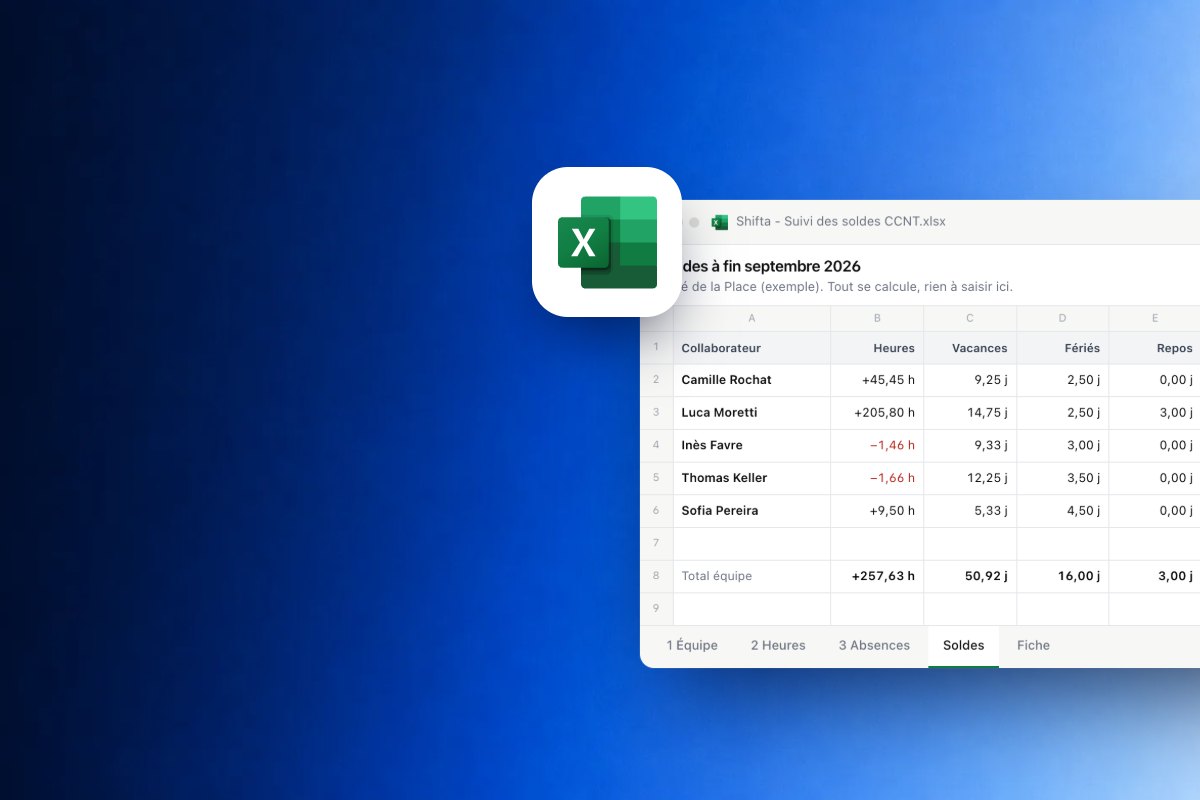
Free Excel template: track your team’s hours and holidays
A ready-to-fill workbook that works out the four L-GAV balances: hours, holidays, public holidays and rest days. Free, sent by email.

Handling last-minute absences without spending an hour on your phone
A text at 16h20, a server off sick. The real cost is invisible: forty minutes lost on the phone, and a replacement nobody records.

Are breaks paid or unpaid in Swiss hospitality?
Unpaid as a rule, unless staff cannot leave their workplace. The legal minimums, the test that actually decides it, and the recording error almost everyone makes.