Sports club team management: cancellations, logged hours and the availability chase

Most club administrators can name the moment their week goes sideways. It is usually a Tuesday around 17h40, and it is a message from a coach who cannot make the 18h30 session. Twenty-two kids, one hall, fifty minutes to fix it.
The real cost is not that one session. It is the forty minutes of calls it triggers, the person who says yes and quietly runs over their contracted hours again, and the fact that none of it gets written down. Repeat that across a season and you get the item clubs never put in a budget: the administrative load of running a team whose schedules never sit still.
Why staff scheduling is harder in a sports club
A club is not one team. It is several overlapping ones, with different contracts and different levels of obligation, sharing the same rooms and the same hours.
A mid-sized club runs with two or three salaried staff, a dozen coaches paid by the session, a reception rota, maintenance, a kiosk on match days, and volunteers whose availability depends on when their own child plays. A salaried receptionist is expected to work the shift they were given. A freelance coach is offering availability, not accepting an instruction. A volunteer is doing the club a favour and can withdraw without consequence.
Standard scheduling tools assume one contract type and one authority relationship. Clubs have neither, and demand is not flat either: term time and holidays look nothing alike, competition weekends double the staffing need for two days, and a single school holiday can invalidate a rota built on a Sunday evening.
What a last-minute coach cancellation actually costs
The visible cost is the session. The real cost is the chain reaction.
Someone has to work out who is qualified for that age group, who is not already working, who is not injured or away, and who has not been asked three times this month. That information rarely sits in one place. It lives partly in a spreadsheet, partly in the head of the person who has been there longest, and partly in a group chat where the answer scrolled past two weeks ago.
Then comes the chase: five or six messages, two calls, one person who accepts if they can leave early. Then comes the part nobody counts. The replacement has worked two unplanned hours, and whether that gets recorded depends on two people remembering to mention it.
The clubs that suffer most from cancellations are not the ones with unreliable coaches. They are the ones where every replacement has to route through one person’s phone. When the manager is the only channel a shift can move through, the manager becomes the bottleneck at the exact moment they have least time.
Why availability management is the job nobody budgeted for
Building the schedule takes an hour or two. Collecting the information needed to build it takes days.
Coaches are students with exam periods, professionals with day jobs, parents with school runs. Availability changes month to month and arrives in whatever form suits the sender: a text, a comment after training, an email with three dates and a maybe, a verbal "I told you I can’t do Thursdays" that may or may not have happened.
So the administrator becomes a collection agent. Send a request, a third reply. Send a reminder, another third. Chase the rest individually, and by then the picture has changed because someone picked up a shift at their other job. A rota built on incomplete availability is a rota that will need fixing later, usually at 17h40 on a Tuesday.
Availability management works when the information flows the other way: people declare when they cannot work, in one place, before the schedule is built, and it stays there. That removes most of the chasing, and it removes the "I did tell you" argument, because there is now a record either way.
Worked hours are never scheduled hours, and that gap is where disputes live
A coach says they worked 34 hours last month. The club has 29. Neither party is lying.
The five hours are made of things nobody schedules: the session that ran over, the setup and clear-up either side, the Saturday tournament agreed verbally in a corridor, the trip to buy cones. Scheduled hours describe an intention. Worked hours describe what happened, and in a club the work spills at both ends of every session.
The problem is that the gap is usually discovered at month end, in a conversation, with no evidence on either side. That leaves two bad options: pay what is claimed and lose control of the wage bill, or dispute it and damage a relationship with someone the club depends on.
Tracking logged hours fixes this, and for a club it almost never means a clocking terminal on the wall. Coaches move between a pitch, a hall and an away venue, so a fixed punch-in point is useless to them. What works is that the person who did the work records what they actually did, at the end of the session, on their phone. The manager sees planned and worked side by side and can question a difference the same week rather than four weeks later. Most hours disputes disappear at that point, not because anyone is caught out, but because there is a shared version of events.
There is a compliance dimension too. Employers must keep working time records for employed staff, and in Switzerland those records have to be retained for five years. A chat history and a mental note do not meet that standard.
Why a group chat is not a scheduling system
Almost every club runs on one, which is what makes it dangerous. A group chat carries information but holds no state. Nobody can look at it and answer "who is working Saturday" without reading backwards. Requests have no status: a time off request answered with a thumbs up is not approved in any useful sense, and both parties will remember it differently.
It also has no boundaries. Staff get messages on days off and at midnight, and session-paid coaches start to feel permanently on call for work they are not being paid for. That is one of the quieter reasons clubs lose good people.
What works instead
The clubs that have this under control are not better organised by temperament. They share four habits, and none of the four requires enterprise software.
What it does require is that the information stops living in one person’s memory and one group chat.
- The schedule lives in one place everyone trusts, readable on a phone between sessions, not a PDF exported on Sunday and already wrong by Tuesday
- Availability and time off arrive before the schedule is built, with a status attached: requested, approved, refused, and no verbal approvals
- Replacements move sideways rather than upwards, so a coach who cannot make a session offers it directly to qualified colleagues or opens it to the group, with the manager confirming rather than orchestrating
- Hours are recorded by the person who worked them, on the day, and compared against what was planned
The clubs that have this under control are not better organised by temperament. They share four habits, and none of the four requires enterprise software.
A note on tools
This is the shape of problem shift scheduling software is built for, and the affordable end of that market has improved. Most clubs assume these tools are priced for chains with fifty sites. Many are, but not all.
Shifta, the product behind this blog, was built for this pattern: small teams, published schedules staff read on their phones, availability and time off requests that carry a real status, shifts passed between colleagues without the manager relaying every message, and hours logged at the end of a session and shown next to what was planned. It came out of Swiss hospitality, where the same Tuesday evening problem exists with a different vocabulary.
The tool matters less than the underlying shift. Clubs lose good coaches and volunteers for unglamorous reasons: hours counted wrong, days off interrupted, a fourth cover request in a month while someone else was never asked. Fixing the schedule is not administrative housekeeping. It is one of the more direct ways a club keeps the people it depends on.
Official sources
- Federal Act on Employment (LTr, SR 822.11), art. 46 on recording working time (in French)
- Ordinance 1 to the Employment Act (OLT 1, SR 822.111), art. 73 on the records and their five-year retention (in French)
- SECO, guidance on the Employment Act
This article is a practical guide to running a club schedule, not legal advice. The working-time rules it mentions are summarised from the official texts linked above, which are what count and are revised from time to time. How they apply to a given coach depends on whether that person is employed or genuinely self-employed, which is a question for the club and its accountant.
Frequently asked questions
Why is scheduling harder in a sports club than in a normal business?
Because a club runs several overlapping teams at once, with different contracts and different levels of obligation in the same rooms and hours: salaried staff who work the shift they are given, freelance coaches who offer availability rather than accept instructions, and volunteers who can withdraw without consequence. Demand is also uneven, since term time, school holidays and competition weekends each need a different staffing level.
What is the quickest way to cover a last-minute coach cancellation?
Stop routing every replacement through one person. When a coach who cannot make a session can offer it directly to qualified colleagues or open it to the group, and the manager only confirms, the cover is found while the manager is still doing something else. The bottleneck in most clubs is not a shortage of willing coaches, it is that one phone has to relay every message.
Do we have to track hours for coaches paid by the session?
For employed staff, Swiss law requires the employer to record actual working time and to keep those records for five years. A coach who is genuinely self-employed and invoices the club is a different relationship, and whether a given person falls on one side or the other is a question for the club and its accountant. Either way, recording the hours protects both sides when a month-end figure is disputed.
Do coaches need a clocking terminal to log their hours?
Almost never in a club. Coaches move between a pitch, a hall and an away venue, so a fixed punch-in point on a wall is useless to them. What works is the person who did the work recording what they actually did at the end of the session, from their phone, with the manager seeing planned and worked hours side by side the same week.
Can we just run the club on a WhatsApp group?
A group chat carries information but holds no state, so nobody can look at it and answer "who is working Saturday" without reading backwards, and a time off request answered with a thumbs up is not approved in any useful sense. It also has no boundaries: staff get messages on days off and at midnight, which is one of the quieter reasons clubs lose good people.
Is scheduling software worth it for a small club?
Most clubs assume these tools are priced for chains with fifty sites. Many are, but the affordable end of the market has improved, and a club with a dozen coaches is exactly the size where the administrative load is largest relative to the staff available to carry it. The test is not the size of the club, it is whether the schedule, the availability and the hours currently live in one person’s memory.
Related articles
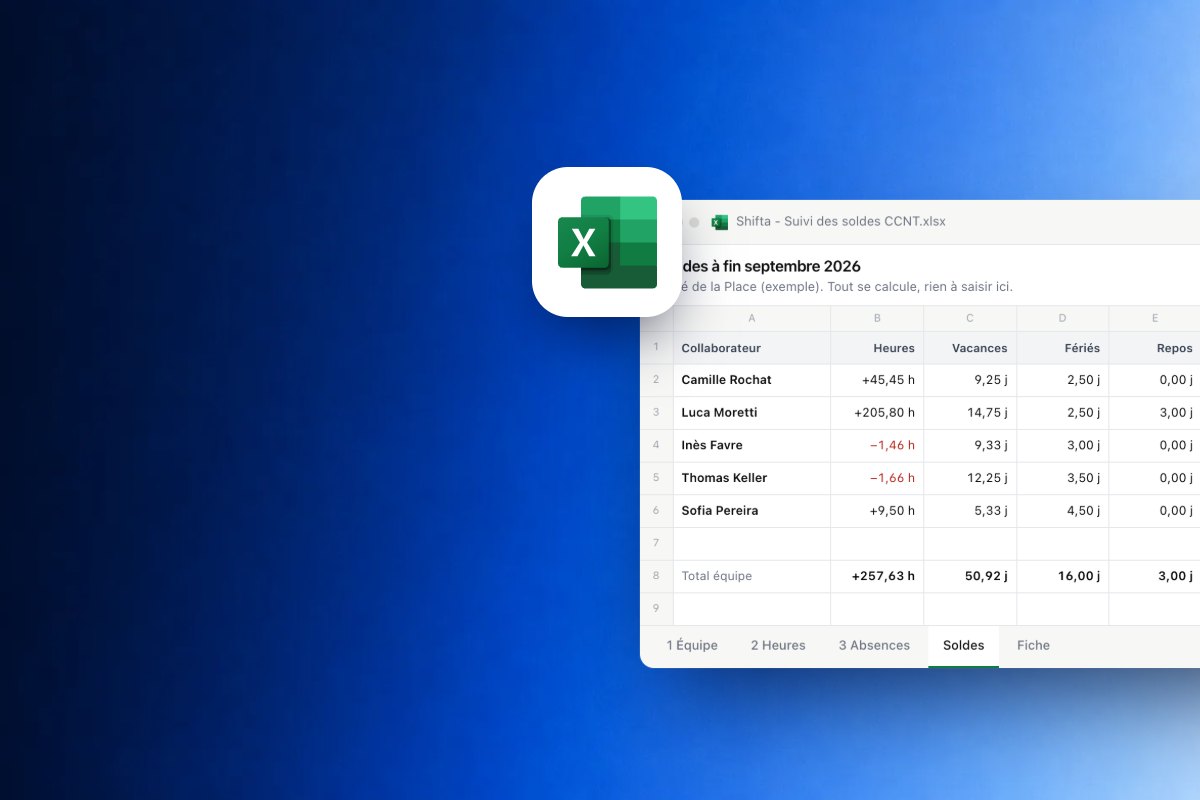
Free Excel template: track your team’s hours and holidays
A ready-to-fill workbook that works out the four L-GAV balances: hours, holidays, public holidays and rest days. Free, sent by email.

The best staff scheduling software in 2026
Seven tools compared for a Swiss venue, one price actually checked, and the three questions that settle it faster than any feature list.

Handling last-minute absences without spending an hour on your phone
A text at 16h20, a server off sick. The real cost is invisible: forty minutes lost on the phone, and a replacement nobody records.